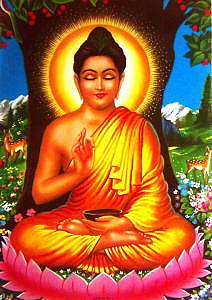
Buddha and Dalai Lama

Wednesday, January 31, 2007

Where I commented...

Hey Ms. Staff,

For homework I commented on Sam's blog and Danny's Blog.

~Hersh

Saturday, January 27, 2007

Buddha Quote

"Believe nothing, no matter where you read it, or who said it, no matter if I have said it, unless it agrees with your own reason and your own common sense." ~Buddha

I chose the quote above because it seemed to have a deep meaning and it would be very useful for people today to know about. What Buddha explains in this quote is simple, its just like the whole: "If your friends did (insert insane stunt here), would you do the same?" The Buddha is saying that everything in the world is nothing or is not right unless it agrees with what you obviously know is right and wrong. It also implies that your common sense and reasoning is one of you most powerful tools and shouldn't be underestimated. I believe that this is a very meaningful and deep quote and I would wish that everyone would be able to read it and understand it.

Throughout the Buddha's life there were many who said that he wasn't strong enough or was not wise enough to go on the journey for enlightenment. He proved them wrong by believing himself and not believing what they were saying and using his own intellect to find the thing that was right to do.

~Hersh

Thursday, January 25, 2007

Quote by the Dalai Lama

Quote: In the practice of tolerance, one's enemy is the best teacher.

This quote means simply that in order to understand your enemy, you must put yourself in their shoes so to speak. You must pretend that you are them and try too look at things as they would look at them. Most of the time, you will find that they are not too different from you.
then you can see that you also would make similar choises in their position. Once you can understand them, you are one step closer to accepting their actions. Hopefully, they can also understand you.

Monday, January 22, 2007

Dalai Lama, Tenzin Gyatso


~Dalai Lama~
Who: The Dalai Lama is believed to be the embodiment of the Buddha. The Dalai Lama is also the spiritual leader of buddhists and governs Tibet. When The Dalai Lama dies, his soul is supposed to inhabit the body of a young child. By running spiritual tests on children, the new Dalai Lama can be determined. The current Dalai Lama, Tenzin Gyatso is 72.

What: One of the Dalai Lama's (and Buddhist's) greatest virtues is tolerence of other religions. Despite the war in Iraque, Buddhist's accept the muslim religion. The main point of the Buddhist religion is the search for enlightenment or the meaning of life. They also are resilient by finding happiness through a time of war. Has to make tough political decisions in Tibet as any leader would.

When: The Dalai Lama was born 72 years ago in 1935. The given child becomes Dalai Lama at the age of 17.

Where: The Dalai Lama is currently living in Tibet, a city in China, as a spiritual, and government leader.

Why: The Dalai Lama does these things in order to promote the Buddhist relgion, as well as fight things such as communism in Tibet (one issue of many).

Buddha: the 5 W's


5 W's Homework

Who: The original Buddha is called Gautama Buddha and his name was Siddhartha Gautama. He was a spiritual teacher from ancient India.

What: He is a major figure of the Buddhist religion, he is also its founder. He achieved "enlightenment" which is, in essence, the meaning of life, or the opening of the inner eye. Buddha journeyed for years to find this and "enlightenment" is what the religion of Buddhism is based off of.

When: Lived in ancient India between 563 BC and 483 BC. Or from the age 29 (when he started his journey) to 35 (when he achieved enlightenment). After, until the age of 80, he traveled around India preaching his doctrines to a diverse amount of people. During this time he established the first Buddhist Monastery.

Where: Throughout the Buddha's life, including his journey to enlightenment, he traveled around India and southern Nepal. Everywhere he went he would be with his loyal partners. While he was traveling he would stay in small villages eating food that was given to him through charity.

Why: He was born royal and had everything he ever might have wanted, but because he wanted to find the reason of suffering he shed his inheritances and went on a journey. He traveled with others who would eventually become to first Buddhist monks. They would travel with almost nothing, no shoes for thousands of miles throughout India. They survived off charity from people in small villages. One day Buddha was sitting under a tree eating a small amount of rice pudding that was given to him by a small girl out of sympathy. Then and there he swore to himself that he would’t leave the tree until he found enlightenment. Months later not leaving the tree he found “Bodhi” or the meaning of life. Even after this he traveled with his partners and taught his religion to almost everyone who would listen. At the age of 80 he died.

~Hersh